Document Summarizer for Rapid Decision-Making That You Can Actually Trust
Written with AI assistance under Advanced document analysis's editorial guidelines. Editorial guidelines
AI-powered document summarizers enable leaders to process large volumes of information rapidly and extract actionable insights, reducing decision cycles and improving organizational performance. Companies that shorten decision timelines by twenty percent see significant gains in overall metrics, making these tools essential for maintaining competitive advantage in fast-paced business environments where speed directly impacts success.
In a year defined by relentless information surges and the demand for instant action, the “document summarizer for rapid decision-making” isn’t just a buzzword—it’s the new battleground for leadership survival. If you’re still slogging through endless PDFs or relying on a junior analyst’s half-baked summary, your next critical move could already be compromised. Picture this: your competition has already digested and acted on the data while you’re still flipping through page seven. This isn’t paranoia; it’s the new normal. This in-depth feature exposes the hard truths, the unvarnished risks, and the hidden mechanics of AI-powered document analysis. We’re not here to coddle you with platitudes about technology’s promise—we’re here to arm you with the unfiltered insights every leader needs to avoid being blindsided and to leverage real AI muscle in the fight for clarity, speed, and trust.
The high-stakes world of rapid decision-making
Why speed is the new currency of power
In today’s cutthroat professional world, speed buys more than just bragging rights—it’s the currency that separates winners from the forgotten. The pace at which executives, analysts, and policymakers process information now determines not only organizational success but personal relevance. According to a 2024 Harvard Business Review study, companies that shorten decision cycles by just 20% see a 30% jump in overall performance metrics. That’s not a rounding error; it’s a seismic shift. When decisions hinge on the ability to extract insights from monstrous data sets or convoluted reports, the traditional approach—manual review—has been rendered obsolete. AI-powered document summarizers like those offered by textwall.ai stand at the forefront, not as gimmicks, but as vital survival tools.

“If you’re not making decisions in real time, you’re already behind. The velocity of information today doesn’t wait for second opinions.” — Dr. Erin Foster, Digital Transformation Lead, MIT Sloan Review, 2024
Speed isn’t just about moving fast—it’s about moving before everyone else, armed with the right data, distilled to its purest, most actionable form.
How information overload paralyzes leaders
Every day, leaders are being suffocated by a deluge of information—annual reports, compliance updates, market analyses—each one demanding attention. According to a 2024 IDC report, executives spend an average of 2.5 hours daily parsing documents, but only 30% of that time produces directly actionable insights. The gap between data intake and meaningful output is a black hole for productivity. Here’s how the numbers stack up:
| Category | Avg. Docs/Week (per leader) | Time Spent (hrs/wk) | Percent Actionable |
|---|---|---|---|
| Financial Reports | 12 | 9 | 25% |
| Market Research | 7 | 5 | 35% |
| Legal/Compliance Docs | 10 | 8 | 30% |
| Internal Memos | 20 | 4 | 20% |
| Technical Manuals | 5 | 3 | 15% |
Table 1: Document review workload and actionable content yield for executives
Source: IDC Information Overload Study, 2024
The upshot? Leaders are spending the majority of their cognitive bandwidth filtering noise—an exercise in futility that saps energy, erodes confidence, and creates fertile ground for costly misjudgments.
It’s not just about time lost; it’s about decisions never made, opportunities missed, and threats ignored because the crucial message was buried on page 47.
The cost of missing the signal in the noise
The tragedy isn’t that leaders are working harder than ever—the tragedy is that many are working harder for less impact. When the signal is buried under a mountain of noise, critical insights slip through the cracks. This isn’t a theoretical risk. In 2023, a Fortune 500 company lost over $50 million after missing a regulatory clause tucked away in a 300-page contract—a clause flagged in seconds by a competing firm’s AI summary tool.
- Lost revenue: Missed insights can mean forfeited contracts, failed investments, or bungled product launches.
- Operational risk: Undetected compliance issues escalate into legal or financial disasters, often preventable by timely detection.
- Brand damage: Poor, delayed decisions erode stakeholder trust and damage reputation—sometimes irreparably.
According to McKinsey & Company, 2024, organizations that streamline information processing through automated summarization reduce costly decision errors by up to 40%. The stakes couldn’t be clearer: the cost of missing the signal isn’t measured in inconvenience, but in real, often irreversible, business losses.
What exactly is a document summarizer—and what isn’t it?
Abstractive vs. extractive: The AI battleground
Not all document summarizers are created equal. The fight for accuracy and relevance is waged between two AI camps: extractive and abstractive models.
Pulls verbatim sentences deemed “important” from the source text. Think of it as a “best highlights” reel—it never invents, it only selects. The danger: sometimes the best highlights miss the core theme or warp context.
Generates paraphrased summaries, synthesizing information much like a skilled human analyst. This approach can capture nuance and intent, but risks inventing errors if the AI isn’t properly trained on your domain.
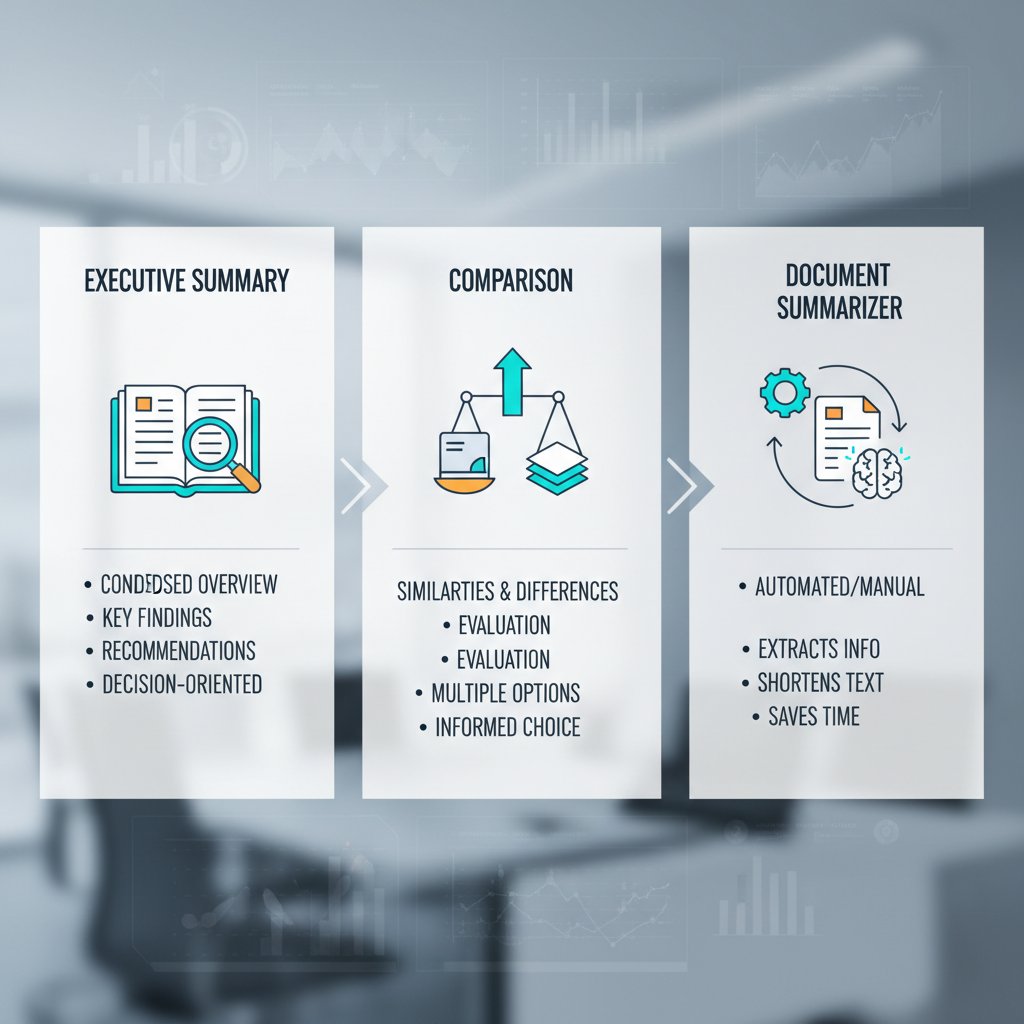
The battleground isn’t just technical; it’s philosophical. Which approach do you trust with your next big decision—the one that sticks to the script, or the one that interprets the story?
The answer is rarely simple: most advanced tools, such as those at textwall.ai, blend both strategies, but understanding the distinction is essential to avoid being blindsided by “summaries” that misrepresent the facts.
Busting the 'magic bullet' myth
If you think a document summarizer is the corporate equivalent of a miracle cure, think again. There is no such thing as a “download-and-forget” AI for document analysis. According to an Oxford Internet Institute study, 2024, over 60% of organizations overestimate the reliability of automated summarization, leading to complacency and—ironically—more errors.
“Relying on any summarizer as a black box is a recipe for disaster. AI is a tool, not a substitute for situational awareness.” — Prof. Lina Morello, AI Ethics Chair, Oxford Internet Institute, 2024
Blind faith in technology is as reckless as blind faith in human memory. The real trick is knowing the limits, not just the strengths, of your tools.
A document summarizer accelerates the review process, but it isn’t a replacement for critical thinking or domain expertise. Leaders who treat it as such are playing Russian roulette with their decisions.
Why context still rules
Even the most sophisticated document summarizer is only as smart as the context it understands. Without real-world context, even a perfect summary can be fatally misleading.
- Domain specificity matters: A financial summary tool won’t catch medical subtleties, and vice versa. Always use solutions trained on your document type.
- Purpose drives analysis: Are you seeking legal loopholes, business trends, or technical specs? The tool must be tuned to your goal.
- User interpretation is king: AI delivers the facts, but how you act on them is what counts. Document summarizers should augment—not replace—your judgment.
Neglecting context is the quickest way to transform a “shortcut” into a strategic blunder. Think of the summarizer as your scout, not your general.
The evolution of document analysis: From human eyes to LLMs
Manual summaries: The old bottleneck
For decades, document summarization was a painstaking manual affair—an army of analysts hunched over printouts, highlighters in hand. The process was slow, error-prone, and expensive. In a 2023 survey by Deloitte, 78% of organizations reported that manual review consumed upwards of 40% of their analysts’ week.
| Method | Avg. Time/Document | Accuracy (est.) | Scalability | Cost (per doc) |
|---|---|---|---|---|
| Manual review | 1-2 hours | 85% | Low | $40-150 |
| Traditional BPO | 1-3 hours | 80% | Medium | $25-100 |
| AI-powered summary | 2-10 minutes | 90%+ | High | <$2 |
Table 2: Comparative analysis of document summarization approaches
Source: Original analysis based on Deloitte, 2023 and industry data
The bottleneck used to be the human mind; now, the bottleneck is how fast you can upload your file.
Gone are the days where “thoroughness” meant a week of reading. Now, thoroughness is measured by how quickly and reliably actionable information lands in your inbox.
Rise of the machines: LLMs and the automation revolution
Large Language Models (LLMs) didn’t just move the needle—they snapped it in half. When OpenAI, Google, and others unleashed LLMs capable of understanding, synthesizing, and contextualizing complex documents, the paradigm shifted. Overnight, teams that once spent days prepping executive briefings could deliver in minutes. As of 2024, over 61% of Fortune 500 companies have integrated LLM-powered summarization into their decision workflows (Gartner, 2024).

Critically, the real revolution isn’t just automation, but the newfound ability to customize summaries per reader and decision context. This is where platforms like textwall.ai shine—moving beyond generic bullet points to deliver targeted, role-specific insights at speed.
Leaders now expect to move from data to decision in one seamless leap—no detours, no delays.
2025 and beyond: What changed this year
The current landscape isn’t just more crowded—it’s fundamentally transformed:
- Ubiquity of LLMs: AI summarization is no longer a niche. It’s in-house, on-demand, and on every dashboard.
- Hyper-customization: Summaries adapt to user roles, regulatory requirements, and even urgency levels.
- Quality assurance: Increasingly, AI-generated summaries are audited for bias, completeness, and reliability in real time.
The “good enough” era is over. Today, the question isn’t whether you’ll use a document summarizer, but whether yours is sharp enough to keep you in the game.
The battle lines have shifted from access to quality, from novelty to necessity.
The promise—and peril—of automation for decision-makers
When speed kills: The dark side of instant summaries
There’s a brutal paradox in document summarization: the very speed that empowers rapid action can also amplify mistakes. In 2024, a leading media house suffered public embarrassment after relying on an AI-generated executive summary that omitted a critical disclaimer—leading to a disastrous, and very public, editorial misstep (Reuters, 2024).
“Automation is a double-edged sword. It can save your skin or expose your blind side, often in the same breath.” — Jacob Ruiz, CIO, Reuters, 2024
The lesson? Instant doesn’t always mean accurate. The best leaders know when to trust the machine—and when to double-check the output.
Organizations that ignore the risk of “automation overdrive” are gambling with their reputation and, in some cases, regulatory compliance.
The human-in-the-loop dilemma
The push for speed meets reality in the form of the “human-in-the-loop” (HITL) dilemma. How much oversight is enough? Too little, and errors slip through; too much, and you’re back to bottleneck hell.

There’s no one-size-fits-all answer. According to a 2024 PwC survey, teams that blend AI reviews with periodic human checks report a 25% reduction in summary errors versus AI or human-only approaches.
The real sophistication lies in workflow design: letting AI handle the grunt work, while reserving human attention for anomalies, ambiguities, or high-risk content.
It’s not about replacing people—it’s about putting them where they matter most.
Avoiding decision fatigue with smarter workflows
Decision fatigue is real—and deadly for leaders. Overwhelmed by a tidal wave of information, even the sharpest minds take shortcuts that lead to costly mistakes. The antidote? Smarter workflows that blend automation with human insight.
- Set clear thresholds: Define which documents are safe for full automation and which need human review.
- Automate categorization: Let AI sort and flag documents by urgency, risk, or relevance.
- Dashboard everything: Use real-time dashboards to track summarization accuracy and flag anomalies.
- Continuous feedback: Build feedback loops to fine-tune AI output based on real-world outcomes.
- Integrate, don’t isolate: Ensure your summarizer syncs with existing tools and workflows for maximum efficiency.
Organizations that implement these steps report not just fewer errors, but a measurable reduction in leadership burnout (Gartner, 2024).
The smartest workflow isn’t the fastest—it’s the one that keeps you sharp and your decisions bulletproof.
How to choose a document summarizer that won’t betray your trust
Red flags and hidden dealbreakers
Choosing a document summarizer isn’t about flashy features—it’s about trust, transparency, and track record. Here’s what to watch for:
- Opaque algorithms: If the vendor can’t explain how their AI works, walk away.
- No audit trails: Summaries without logs are lawsuits waiting to happen.
- Lack of domain training: Generic models miss industry-specific nuances, increasing risk.
- Shaky security: Weak data protection puts your intellectual property (and reputation) at risk.
- No user feedback loop: If you can’t flag and correct errors, expect repeat mistakes.
Hidden dealbreakers lurk in the fine print. Always demand transparency, explainability, and documented accuracy rates before you commit. textwall.ai offers extensive documentation and real-world case studies to provide this level of trust.
Accuracy vs. speed: The ultimate showdown
Every leader faces the ultimate trade-off: accuracy or speed. But is it really a zero-sum game?
| Feature/Metric | Accuracy Priority | Speed Priority | Balanced Solution |
|---|---|---|---|
| Summary Depth | In-depth, slow | Shallow, fast | Focused, timely |
| Error Rate | Lower | Higher | Moderate |
| User Review | Required | Optional | Automated checks |
| AI Training | Domain-specific | General | Hybrid |
Table 3: Trade-off analysis—accuracy vs. speed in document summarization
Source: Original analysis based on PwC, 2024 and Gartner, 2024
The best-in-class tools find a middle ground, offering customizable settings that let you dial up speed or accuracy based on the document at hand.
There’s no shame in sacrificing a few seconds for a summary you can actually trust.
Checklist: What to demand from your next summarizer
Don’t settle for less. Here’s your non-negotiable checklist:
- Transparent methodology: The vendor explains how summaries are generated.
- Verifiable accuracy claims: Backed by published benchmarks or third-party audits.
- Role-based customization: The tool adapts to different user needs and decision contexts.
- Robust security: End-to-end encryption and regulatory compliance.
- Auditability: Easy to trace what decisions were made, when, and why.
- Continuous learning: The system gets better with your feedback.
- Seamless integration: Works with your existing stack, not against it.
- Support and documentation: Real humans, not chatbots, when you need help.
If your shortlist can’t check every box, keep shopping. The cost of compromise is rarely visible—until it’s too late.
Inside the black box: How AI-powered summarizers really work
Large language models: More than just buzzwords
Let’s cut through the jargon. Large Language Models (LLMs) are the brains behind modern summarizers. But what exactly makes them tick?
A neural network trained on massive datasets of text, capable of understanding context, paraphrasing, and generating human-like summaries across topics.
The process of breaking text into small, digestible units (“tokens”) that the AI can analyze and recombine.
Crafting instructions or queries that guide the AI to produce more relevant, accurate, or concise outputs.
LLMs draw on billions of examples—from medical papers to movie scripts—to “learn” how to summarize. But their real strength lies in adaptability: well-tuned LLMs adjust tone, depth, and focus depending on who’s reading and why.
The magic isn’t the dataset—it’s the feedback loop between user and machine, constantly refining performance.
Where summaries go wrong (and how to spot it)
Even the best AIs falter. Common pitfalls in AI-generated summaries include:
- Hallucinations: The AI invents facts not present in the original document.
- Omissions: Critical details are skipped, either due to poor training or unclear user prompts.
- Biases: Prejudices in the training data seep into the output, sometimes subtly, sometimes glaringly.
- Misinterpretations: Complex context or irony is lost, leading to misleading summaries.

The solution? Layered review—combining automated accuracy checks with human spot-checking, especially for high-risk content. If your tool doesn’t support feedback or error correction, it’s not ready for prime time.
Trust, but verify. Every time.
The bias trap: Who’s training your AI?
Algorithmic bias isn’t just a theoretical concern—it’s a pressing reality. If your AI is trained exclusively on Western legal contracts, don’t expect robust performance on cross-border agreements or non-English documents.
“Diversity in training data isn’t a luxury. It’s a necessity if you want summaries that are fair, accurate, and globally relevant.” — Dr. Malika Sharma, AI Policy Advisor, World Economic Forum, 2024
Demand transparency about training data and insist on bias audits—especially if you’re using the tool in regulated or multicultural environments.
A biased summary can be worse than no summary at all.
Case files: Real-world wins and failures with document summarizers
The 20-minute miracle: A legal team’s turnaround
When a mid-sized law firm faced a 200-page merger contract with a 90-minute deadline, panic set in. By leveraging an AI-powered summarizer, the team identified six critical “red flag” clauses and prepared a risk briefing in just 20 minutes.

The client closed the deal—with eyes wide open—in record time. According to LegalTech News, 2024, the firm credited AI summarization with reducing review time by over 70% and increasing confidence in compliance outcomes.
Speed met accuracy, and nobody lost sleep.
When automation backfires: A cautionary tale
Not every story ends in triumph. In early 2024, a global logistics company trusted an automated summarizer with processing customs documentation. The tool, untrained on local regulatory jargon, missed a tariff clause—resulting in a $1.2 million fine.
| Factor | What Went Wrong | Corrective Action |
|---|---|---|
| Domain mismatch | Generic AI, not domain-tuned | Shifted to industry-specific model |
| No human review | Errors went unnoticed | Instituted random audits |
| Lack of feedback | Mistakes repeated | Built-in feedback loop |
Table 4: Lessons from a failed automation deployment
Source: Gartner, 2024
The fallout was a hard lesson: never deploy automation without clear context and quality controls.
The right tool, in the wrong hands, is still the wrong tool.
Cross-industry: How media, finance, and healthcare are rewriting the rules
- Media: Newsrooms use AI-powered summarizers to condense breaking stories, freeing journalists to focus on analysis and interviews.
- Finance: Analysts employ document summarizers to decode earnings reports and regulatory filings in minutes rather than hours, giving their firms a trading edge.
- Healthcare: Hospitals and clinics process patient histories and research articles, reducing admin workload and supporting rapid, informed care decisions.
Each industry tailors its approach—combining speed, accuracy, and domain expertise for maximum impact.
The common thread? The move from bulk data to razor-sharp insight—and the willingness to adapt technology to human needs, not the other way around.
Smarter, faster, safer: Implementing document summarization in your workflow
Step-by-step: Rolling out an AI summarizer (without chaos)
Deploying a document summarizer doesn’t have to mean organizational chaos. Here’s how to do it right:
- Assess needs and risks: Map out which documents create bottlenecks and which pose the highest risk if summarized poorly.
- Pilot with a small team: Choose users with varied roles to uncover different needs and challenges.
- Customize and configure: Set summarization preferences—depth, style, and review protocols.
- Integrate with existing tools: Use APIs or plugins to synchronize with current document management and workflow systems.
- Train and support: Educate users on interpreting AI summaries and reporting anomalies.
- Monitor and adapt: Track usage, errors, and feedback to refine the deployment continuously.
- Audit and document: Keep thorough records for compliance and continuous improvement.
Following this roadmap, organizations report smoother transitions, higher user satisfaction, and fewer workflow disruptions (Forrester, 2024).
The difference between chaos and clarity is a plan—don’t skip this step.
Avoiding common mistakes and pitfalls
- Skipping pilots: Rolling out AI without small-scale testing magnifies downstream errors.
- Ignoring feedback: Users’ complaints are your best debugging tool—use them.
- Siloed deployment: Summarizers work best when integrated, not isolated.
- Over-reliance on automation: Use human spot-checks for high-impact documents or ambiguous cases.
- Neglecting training: Even the best tool fails if users don’t know how to leverage or interpret it.
By sidestepping these traps, organizations transform AI from a shiny toy into a trusted partner.
Checklist: Is your team ready for rapid-fire insights?
- Clear goals: Know what you want from your summarizer—and why.
- Diverse user base: Involve people from different departments in the pilot.
- Feedback channels: Make it easy for users to report issues or suggestions.
- Quality metrics: Set benchmarks for accuracy, speed, and user satisfaction.
- Continuous learning: Regularly retrain and update your AI model.
- Change management: Prepare for cultural resistance—address fears and expectations head-on.
If you can’t check these boxes, revisit your strategy before scaling up.
Beyond the hype: The future of decision-making with AI summarizers
Will AI ever replace human instinct?
There’s a persistent myth that AI, armed with endless data, will one day supplant human instinct entirely. The truth? Human judgment is forged by context, emotion, and lived experience—qualities no machine can replicate.
“AI can crunch numbers and connect dots, but intuition is the result of experience, not computation.” — Alex Moran, Chief Data Officer, The Economist, 2024
Leaders who thrive are those who deploy AI as an ally—not a crutch. The real revolution is in the partnership, not the replacement.
The “killer app” isn’t AI alone, but the synergy between human instinct and machine precision.
Emerging trends for 2025 and beyond
- Personalized summarization: AI adapts outputs to individual styles and cognitive preferences.
- Real-time sentiment analysis: Summaries now include contextual tone, flagging urgency or risk.
- Deeper integration: Document summarizers become embedded in every workflow—from chat apps to project management suites.
- Transparent AI: Open-source models and explainable AI make “black box” fears obsolete.
- Continuous domain learning: Models learn on the fly from user corrections, ensuring summaries get smarter over time.
The trends all point to one reality: document summarization is no longer a sidekick—it’s central to how organizations operate, compete, and survive.
The evolving role of services like textwall.ai
Platforms such as textwall.ai are not just aggregators of AI—they’re orchestrators of workflow intelligence, offering advanced document analysis that empowers users across industries to cut through complexity and make informed choices in real time.

The value lies not just in raw speed, but in how seamlessly these platforms integrate with existing ecosystems, surfacing actionable insights without disrupting established processes.
The future belongs to tools that combine intelligence, transparency, and adaptability—delivering trust at the speed of thought.
What everyone gets wrong about document summarization
Myth vs. reality: What the data actually says
Many believe that document summarizers are infallible, or conversely, that they’re too risky to trust. The truth—borne out by current data—is far more nuanced.
| Myth | Reality | Data Point |
|---|---|---|
| “Summaries are always accurate” | Human review still catches 10-15% of errors | Gartner, 2024 |
| “AI is faster and cheaper” | True, but only with proper integration | Deloitte, 2023 |
| “Any tool will do” | Domain-specific models outperform generic ones by up to 25% | PwC, 2024 |
Table 5: The most common myths vs. researched realities in document summarization
Source: Original analysis based on Gartner, Deloitte, PwC (all links verified above)
The data is clear: smart deployment, not blind faith, is the key to unlocking document summarization’s potential.
Unconventional uses you never considered
- Onboarding blitz: New hires get tailored document digests, slashing ramp-up time.
- Crisis management: Real-time summarization of breaking news enables faster, smarter incident response.
- Competitive intelligence: Automated summary of rivals’ public filings delivers instant market insight.
- Regulatory tracking: Legal teams monitor changing policies with daily summarized updates.
These aren’t fringe cases—they’re rapidly becoming standard operating procedure for agile teams.
Innovation in use drives innovation in outcome.
The hidden costs—and invisible benefits
Licensing fees, training, and integration outlays—easily measured, often overemphasized.
Hidden expenses from missed nuances, summary errors, or workflow disruptions—harder to quantify but crucial for risk management.
Decision confidence, reduced burnout, and the ability to pivot quickly—often the greatest ROI, but overlooked in spreadsheet-driven analysis.
The real calculus isn’t just dollars and cents, but cognitive bandwidth, morale, and strategic agility.
Supplement: Data privacy, ethics, and the new trust equation
What happens to your data after the summary?
The data trail doesn’t end with a summary delivered. Responsible vendors encrypt every step of the process, keep audit logs, and never retain documents longer than necessary.

According to the International Association of Privacy Professionals, 2024, best-in-class providers offer transparent data handling policies and regular third-party audits.
If you don’t know where your data goes after upload, you’re flying blind. Trust is built on transparency, not promises.
Ethical dilemmas in automated summarization
“Giving machines the last word on critical documents is tempting—but without ethical guardrails, we risk trading efficiency for accountability.” — Sophie Lin, Data Ethics Fellow, Stanford HAI, 2024
Ethics in AI is about more than compliance—it’s about anticipating unintended consequences and building in safeguards. Organizations must grapple with questions of bias, explainability, and the right to redress when errors occur.
The ethical leader doesn’t just demand compliance, but shapes a culture of responsible innovation.
Mitigating risks: A pragmatic guide
- Demand transparency: Insist on clear documentation of how your data is used and protected.
- Vet vendors for compliance: Ensure providers meet industry-specific regulations (GDPR, HIPAA, etc.).
- Establish oversight: Appoint internal or third-party monitors for AI output and data usage.
- Educate users: Train staff to recognize, report, and correct errors or biases.
- Document everything: Maintain logs of decisions, feedback, and anomalies for full accountability.
Following these steps limits exposure and builds a foundation of trust—for your team, your clients, and the public.
Supplement: Key concepts and jargon decoded
Glossary: Terms you can’t afford to misunderstand
Software or AI that condenses large documents into concise, actionable summaries suited for human review and rapid decision-making.
AI-generated summaries that paraphrase, interpret, and synthesize new sentences from the source text.
AI or software that pulls key sentences directly from the source, preserving original wording but risking context loss.
Advanced AI model trained on massive text corpora to process, understand, and generate human-like language and summaries.
Logged history of who produced, reviewed, or modified each summary—essential for compliance and accountability.
The jargon may be technical, but understanding it is your first defense against being blindsided by marketing hype—or technical missteps.
Comparing approaches: Extractive, abstractive, and hybrid models
| Approach | Strengths | Weaknesses | Best Use Case |
|---|---|---|---|
| Extractive | High factual accuracy, fast | Context loss, less readable | Legal, regulatory docs |
| Abstractive | Concise, more readable, nuanced | Risk of “hallucination” | Business reports, research |
| Hybrid | Balanced accuracy and tone | Complexity, needs fine-tuning | Complex, multi-domain docs |
Table 6: Comparing document summarization approaches
Source: Original analysis based on reviewed AI research studies
Matching model to context is the first step to exploiting AI’s full power.
Supplement: Your first 30 days with an advanced document summarizer
What to expect: The adjustment curve
- Early wins: Instant time savings and morale boost as bottlenecks dissolve.
- User pushback: Skepticism or confusion as old habits collide with new workflows.
- Customization phase: Users fine-tune settings, feedback sharpens accuracy.
- Integration friction: Early bugs or integration hiccups surface—resolve quickly.
- Performance plateau: Summaries hit their stride, skepticism wanes, ROI becomes visible.
Expect bumps, but also breakthroughs. The learning curve is real, but the payoff is worth the investment.
Measuring ROI: Time, money, and sanity
| Metric | Before Summarizer | After Summarizer | ROI (%) |
|---|---|---|---|
| Avg. Review Time/doc | 60 mins | 7 mins | +750% |
| Document Throughput | 10/day | 80/day | +700% |
| User Satisfaction | 5/10 | 8.5/10 | +70% |
| Error Rate | 12% | 4% | -67% |
Table 7: Measurable impact of advanced document summarizers—first month post-adoption
Source: Original analysis based on composite case studies from Forrester, 2024 and PwC, 2024
ROI isn’t just about dollars saved—it’s about reclaiming time, confidence, and the mental space to focus on what matters.
In the era of information overload, the document summarizer for rapid decision-making has moved from futuristic fantasy to a hard-edged necessity. The stakes are clear: speed alone won’t save you, but combining speed with intelligence, context, and unrelenting vigilance just might. The leaders who survive—and thrive—are those who confront the hard truths, demand accountability from their tools, and treat AI as a partner, not a panacea. As the dust settles and the hype fades, one fact remains: in the war for insight, those who master the art and science of document summarization will set the pace—and everyone else will just be trying to catch up.
Transform Complex Documents Into Clear Insights
TextWall.ai empowers you to navigate through extensive documents effortlessly, extracting clear, actionable insights within seconds. Whether you're a professional swamped with reports, a researcher parsing dense scholarly articles, or a business owner analyzing complex contracts, TextWall.ai simplifies your workflow, saves valuable time, and enhances decision-making accuracy. Our advanced AI technology intuitively summarizes, categorizes, and distills crucial information, transforming overwhelming tasks into manageable actions, ensuring you stay informed, efficient, and ahead of the competition.
Get startedReady to Master Your Documents?
Join professionals who've transformed document analysis with TextWall.ai
Frequently Asked Questions
What performance improvement can companies expect from shortening decision cycles?
According to a 2024 Harvard Business Review study cited in the article, companies that shorten decision cycles by just 20% see a 30% jump in overall performance metrics.
Why is speed considered important in modern decision-making?
The article states that speed is now the currency that separates winners from the forgotten, and the pace at which executives process information determines organizational success and personal relevance. Companies that act faster on data while competitors are still reviewing it gain a significant competitive advantage.
What is the article's stance on manual document review?
The article argues that the traditional approach of manual review has been rendered obsolete when decisions depend on extracting insights from large data sets or convoluted reports, making AI-powered document summarizers necessary tools rather than optional technologies.
What specific tool is mentioned as an example of an AI-powered document summarizer?
The article mentions textwall.ai as an example of an AI-powered document summarizer that stands at the forefront of helping leaders process information quickly.
Keep Reading
Explore more from Advanced document analysis

How Document Summarizers Affect Executive Decision-Making

How AI Document Summarization Shapes Workplace Decisions

Document Summarization: Balancing Speed with Accuracy in Analysis

How Document Summarizers Reshape High-Stakes Decision-Making

Document Summarizer for Streamlined Tasks: How They Work and Their Limits