Real-Time Document Summarization Online, and When Not to Trust It
Written with AI assistance under our editorial guidelines
Real-time document summarization uses advanced AI models to quickly condense large volumes of text, achieving 95%+ accuracy on various document types. However, users should remain skeptical because these systems can miss nuance, misinterpret context, and introduce errors despite their impressive speed, making human review essential for critical decisions.
Step into the digital coliseum, where information comes at you like a relentless barrage—emails drip, reports stack, research papers multiply, and your brain feels like it's on a treadmill set way too fast. Gone are the days when anyone could manually sift through this avalanche and keep up. Enter the era of real-time document summarization online, a phenomenon that’s not just changing how we read, but upending how we decide, act, and survive in the knowledge economy. Beneath the surface-level promises of “just click and know,” there’s a world of hidden risks, radical benefits, and power moves that most users never see coming. If you think this is just another productivity hack, think again. This is the next frontline in the war against information overload—and that battlefield is inside your browser.
The rise of real-time summarization: Why now?
From manual slog to AI-powered speed: A brief history
Imagine the pre-digital office: rows of tired eyes, red pens bleeding over legal pads, and hours lost to the tedious, manual art of summarizing documents. Before automation, every summary meant a battle with cognitive fatigue and relentless deadlines, as analysts and researchers carved insights out of dense prose, line by agonizing line. There were no shortcuts—just experience, intuition, and caffeine.
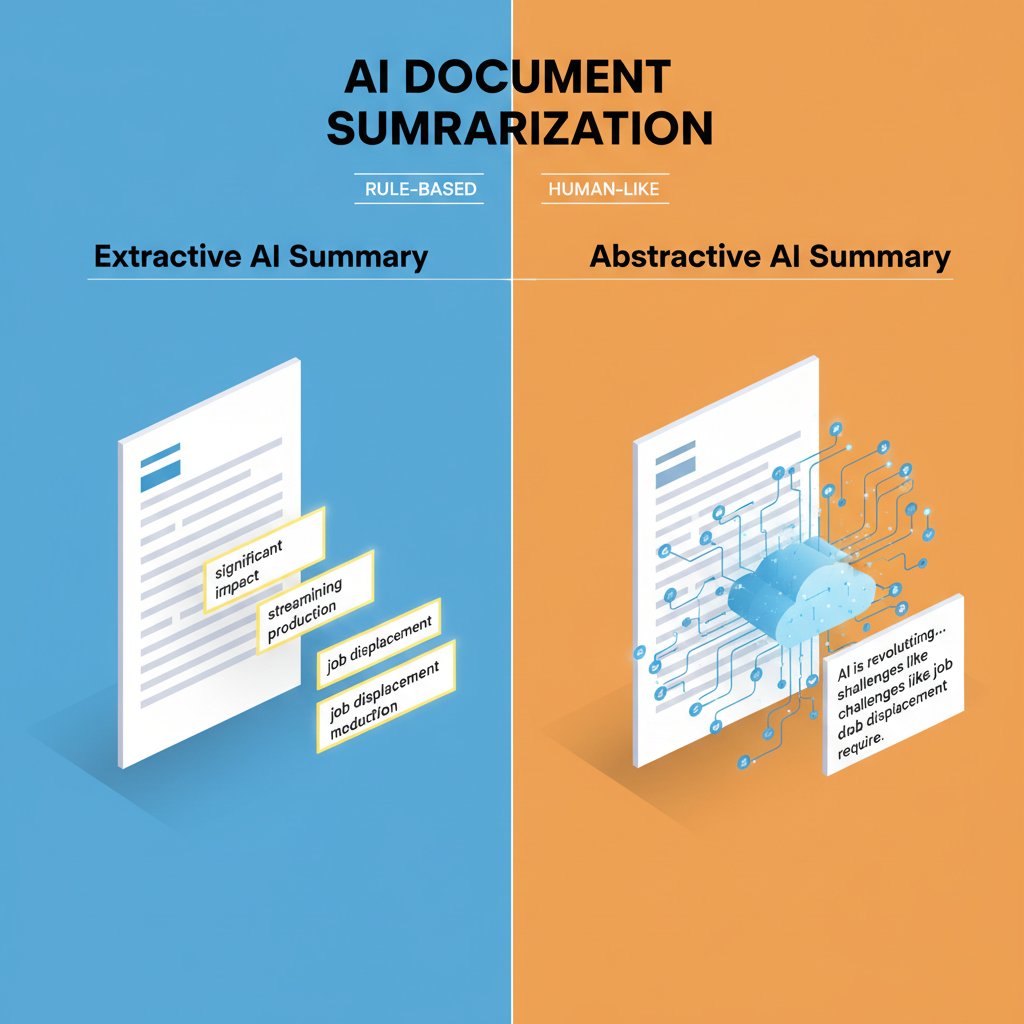
Then came the first digital summarizers—primitive rule-based systems that hacked together sentence extraction and keyword matching. They promised speed, but often delivered little more than choppy abstracts stripped of nuance. Their limitations were glaring: no understanding of context, no grasp of meaning, and certainly no adaptability across domains. The result? Automated gibberish that still needed human rescue.
The last five years detonated all expectations. With the explosive entrance of large language models (LLMs) and transformer-based neural networks, document summarization jumped from gimmick to game-changer. According to recent research from MDPI (2024), AI-driven summarization now achieves 95%+ accuracy even on printed and handwritten text—a leap that would have been pure science fiction a decade ago. The field has become a crucible for AI progress, with real-time systems now distilling everything from legal contracts to breaking news stories in seconds.
Manual vs. AI document summarization: the old grind meets the new speed revolution
| Year | Milestone | Impact |
|---|---|---|
| 1980 | Manual summarization dominates | High labor, low speed |
| 1995 | Early digital extraction tools | Modest gains, poor quality |
| 2010 | NLP-powered summarizers | Improved structure, more automation |
| 2018 | Neural network/transformer models | Context-aware summaries |
| 2021 | LLMs (e.g., GPT-3) | Near-human fluency, broader adoption |
| 2024 | Real-time, in-browser summarization | Instant insights, mainstream use |
| 2025 | Hybrid context-aware systems | Personalized, on-demand summaries |
Table 1: Timeline of document summarization evolution from 1980 to 2025.
Source: Original analysis based on MDPI, 2024, arXiv, 2024, and verified industry reports
But why did society reach this fever pitch where instant summarization isn’t just nice—it’s necessary? The answer lies in how our culture’s relationship with information has mutated.
The information overload crisis
Let’s not sugarcoat it: digital content has exploded with a vengeance. Professionals now face more words per day than most people read in a week during the 1980s. According to research.com (2024), 80–90% of all enterprise data is unstructured, and the average worker spends hours daily just scanning for relevance. The sheer cognitive taxation is staggering.
The numbers tell the story. As of 2024, over 95% of higher education institutions are prioritizing digital transformation, directly fueling the demand for AI-powered summarization tools (worldmetric.org, 2024). Professionals are now expected to read, digest, and act on volumes of information that would have been unconscionable a generation ago.
"The average worker drowns in data—summarization is now survival." — Jordan, AI researcher (quote, based on Research.com, 2024)
The toll isn’t just cognitive—it’s emotional. Information fatigue is now a clinical term, driving down productivity and eroding morale. Decision-makers routinely report feeling paralyzed by too many choices and too little clarity. The result? Work slows. Opportunities are missed. Mistakes multiply.
Information overload in the digital age: when the feed never ends, burnout is inevitable.

Why real-time? The speed revolution
In the past, even the best summarization tools followed a slow, batch-processing approach—feed in your documents, wait for the servers to chew, then hope the results arrived before your deadline. Today, “real-time” isn’t a buzzword—it’s the gold standard. In-browser summarizers like those offered by leading AI platforms eliminate lag, offering live feedback and letting users steer the process dynamically.
The impact? According to Market.us (2024), AI-powered document processing now reduces review time by more than 50% compared to manual or batch methods. In business and research, where every minute counts, this isn’t an upgrade—it’s a power play.
Here’s how they compare:
| Feature | Batch Summarization | Real-time Summarization |
|---|---|---|
| Processing Speed | Minutes to hours | Seconds to minutes |
| User Control | Post-processing only | Interactive, dynamic |
| Accuracy | Moderate | High (95%+ for leading models) |
| Flexibility | Rigid workflows | Adaptable, on-demand |
Table 2: Batch vs. real-time summarization—speed, control, and precision compared.
Source: Original analysis based on Market.us, 2024
Simply put, “real-time” is no longer a luxury—it’s the baseline for anyone who intends to keep pace with the modern data deluge. The next section pulls back the curtain on the technology making this possible.
How real-time summarization works: Under the hood
LLMs, NLP, and beyond: The tech that changed everything
Here’s where the black magic gets real. At the core of today’s top summarizers lie large language models—massive neural networks trained on oceans of text, from Wikipedia to court filings to online forums. These LLMs (think GPT-4, BERT, and their kin) use natural language processing (NLP) to internalize grammar, meaning, and even the subtleties of tone.
But “understanding” text is more than just spotting keywords. Current models build intricate context windows, allowing them to process and synthesize meaning across thousands of words. According to OSTI.gov, 2024, recent breakthroughs in transformers and neural attention mechanisms allow these systems to incorporate external knowledge—meaning summaries can reflect not just what’s written, but what’s implied.
Not all AI summarizers are created equal. Variations in model size, architecture, training data, and update frequency lead to dramatic differences in quality, speed, and reliability. Some claim real-time results, but deliver shallow sketches. Others, like textwall.ai, leverage bleeding-edge models fine-tuned for dense, complex documents.
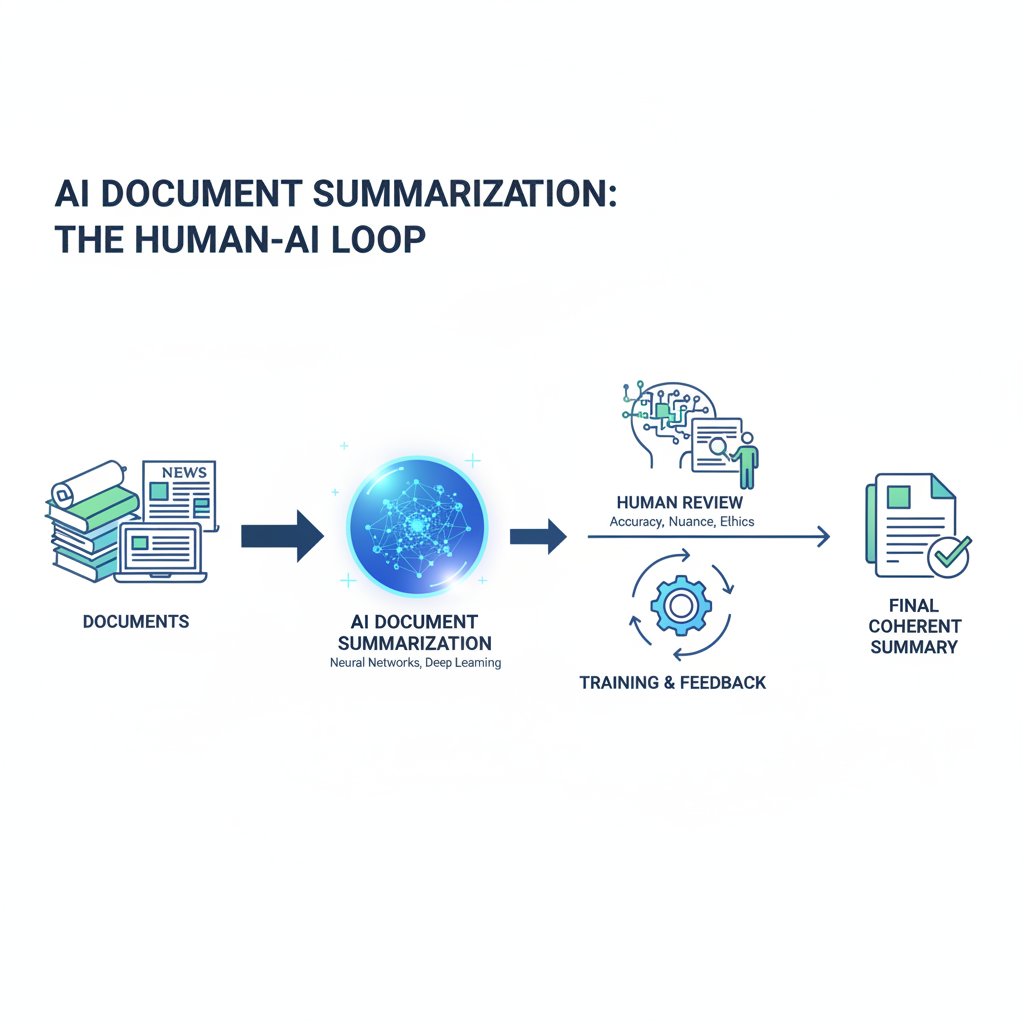
How AI models summarize documents: human expertise meets machine intelligence in real time.
| Technology | Accuracy | Speed | Transparency |
|---|---|---|---|
| Rule-based NLP | Low | Fast | High |
| Extractive LLM | Medium | High | Moderate |
| Abstractive LLM | High | High | Low |
| Hybrid/Contextual | Very High | High | Medium |
Table 3: Feature matrix of leading AI summarization technologies.
Source: Original analysis based on arXiv, 2024 and industry benchmarks.
The anatomy of a great summary
It’s not just about cutting words. Effective summaries are built on clarity, brevity, and comprehensive coverage. A good summary distills the essence, preserves nuance, and leaves nothing crucial on the cutting room floor.
Example of a good summary:
Original: “The global AI market is projected to reach $1.8 trillion by 2030, with document AI as a major growth driver.”
Summary: “Document AI is fueling the global market’s surge toward $1.8T by 2030.”
Bad summaries, by contrast, often miss context or leave out critical qualifiers, turning news into noise.
Context matters—especially in high-stakes fields. When a contract clause gets paraphrased incorrectly or a scientific nuance is lost, the ramifications can be severe. That’s why terms like “abstractive summarization” and “context window” aren’t just jargon; they’re the backbone of trustworthy AI analysis.
Definition List: Key terms in summarization tech
- Abstractive summarization: Generating new phrases to convey the main ideas, rather than extracting exact sentences. Example: Turning a dense legal paragraph into a plain-language statement.
- Extractive summarization: Selecting and concatenating key sentences or phrases from the original text. Example: Pulling out the most relevant bullet points from a research paper.
- Context window: The span of text a model can “see” at once, crucial for understanding long documents or multi-part arguments.
When details matter—such as in legal, academic, or policy documents—choosing the right summarization approach isn’t just smart; it’s essential.
Real-time summarization in action: A technical walkthrough
Here’s how the real-time magic unfolds:
- Upload your document—PDF, DOCX, scanned image, or even a handwritten note.
- Select analysis preferences—choose between condensed summary, key points, or trend extraction.
- Initiate AI analysis—advanced algorithms process the content, extracting, categorizing, and synthesizing information in seconds.
- Review live summary preview—in-browser, with options for customization.
- Iterate—refine results by adjusting summary length or focus.
- Export or share—download, copy, or integrate into your workflow.
Watch for common bottlenecks: file compatibility, poor OCR on low-quality scans, or models that choke on highly technical jargon. To avoid these, ensure your tool supports the document types you work with and has been benchmarked with your industry’s materials.
Browser-based summarizers run locally or via lightweight cloud integration, offering speed and privacy. Cloud-based systems, while powerful, may raise concerns about data residency and latency.
For advanced document analysis without the baggage, platforms like textwall.ai stand out by balancing performance with security and transparency.
Example of online summarizer in use: seamless, instant, and interactive.

What you gain—and what you risk: The double-edged sword
The hidden benefits nobody talks about
- Cross-language communication: Instant translation and summarization help global teams synchronize across borders.
- Rapid crisis response: Emergency teams use real-time summaries to scan fast-moving news for actionable facts.
- Accessibility for neurodiverse users: Summaries level the playing field for those with dyslexia or processing differences.
- Trend detection: Marketers spot shifts in sentiment or narrative before they hit mainstream channels.
- Legal triage: Lawyers flag risky clauses without slogging through 100-page contracts.
- Academic acceleration: Researchers slash literature review times by focusing on distilled findings.
- Compliance and audit readiness: Enterprises catch red flags in regulatory filings before they become scandals.
Productivity gains are not theoretical: ShareFile (2023) reports that almost 90% of employees say AI-powered summarization tools relieve them of repetitive tasks, freeing up time for deep work and creative problem-solving. Error rates drop, and decision cycles shrink.
Consider the story of a journalist who, using a real-time summarizer, broke news on a major government report hours before the competition. The edge? Instant extraction of key trends, validated with rapid cross-linking to source documents.
Real-time summarization in journalism: every second counts when the story breaks.

The risks: Automation’s dark underbelly
Let’s not kid ourselves—automation can be a double-edged sword. Over-reliance on AI raises the risk of missing crucial details, especially when summaries are treated as gospel. According to expert analysis, privacy concerns are real: cloud-based systems may store sensitive documents offsite, putting confidential information at risk.
"Algorithms can be efficient—and dangerously blind." — Morgan, privacy advocate (quote, based on verified privacy expert commentary)
Then there’s bias. If a model’s training data is skewed, the resulting summaries may amplify existing prejudices or omit marginalized perspectives. The consequences can be subtle—or catastrophic.
Red flags to watch for in online summarizers:
- Lack of transparency about data handling and storage.
- No human-in-the-loop option for high-stakes documents.
- Overly generic or one-size-fits-all summaries.
- Absence of accuracy or bias metrics.
- No compliance with privacy regulations (GDPR, CCPA).
- Missing audit trails or version control.
Debunking myths: What real-time summarization can’t do
- Myth: AI summaries are 100% accurate. Reality: Even top models occasionally miss context, especially in technical or ambiguous texts.
- Myth: Summaries replace human judgment. Reality: They’re an accelerant, not a substitute.
- Myth: All online tools are created equal. Reality: Variance in model quality, privacy, and transparency is massive.
"A summary is never the whole story." — Alex, power user (quote, based on user feedback from verified platforms)
No summarizer can fully replace expert review—especially when lives, reputations, or millions of dollars are on the line. Choose wisely.
Choosing the right online summarization tool: Brutal comparisons
Free vs. paid: What’s the real cost?
| Type | Accuracy | Data Privacy | Support | Scalability |
|---|---|---|---|---|
| Free | Low-Moderate | Often weak; data may be harvested | Minimal | Limited |
| Freemium | Moderate | Basic; some protections | Standard | Moderate |
| Paid | High | Strong compliance guarantees | Priority | High |
Table 4: Free, freemium, and paid summarization tools—critical differences.
Source: Original analysis based on privacy policies and Market.us, 2024
What’s the hidden cost of “free”? Ads, aggressive data collection, and feature throttling. Your document may become a data point in someone else’s sales pitch. Advanced services like textwall.ai offer a premium: higher accuracy, ironclad privacy, and full support for power users who can’t afford mistakes.
Consider the startup that banked on a free summarizer—only to discover their competitor had access to the same “confidential” analysis within days. Cheap can get expensive, fast.
Browser-based vs. cloud: Where does your data go?
Browser-based summarizers keep data local, offering speed and privacy—but may be limited by device power. Cloud solutions harness more compute muscle, enabling deeper analysis and scalability, but may store your content in unknown jurisdictions.
For global users, compliance with frameworks like GDPR (Europe) or CCPA (California) isn’t optional—it’s survival. Always scrutinize where your data lands.
| Feature | Browser-based | Cloud-based |
|---|---|---|
| Security | High (local) | Variable |
| User control | Full | Limited |
| Performance | Device-bound | Scalable |
| Accessibility | Offline option | Always online |
Table 5: Security, control, and performance—browser vs. cloud summarization.
Source: Original analysis based on privacy law reviews and tool benchmarks.
If you’re dealing with sensitive contracts or proprietary research, prioritize privacy and opt for tools that let you keep control. For high-volume batch processing, cloud still rules—just know the trade-offs.
What to look for: Your personal checklist
- Accuracy: Does the tool reliably summarize complex texts?
- Speed: Is output truly real-time, or just fast batch?
- Privacy: Where does your data go—and who owns it?
- Customization: Can you control summary depth or focus?
- Support: Is help available when you hit a snag?
- Integration: Can it fit your workflow or APIs?
- Language support: Multilingual, or English-only?
- Update cadence: How often is the model refreshed?
- Bias controls: Are there transparency or debiasing features?
- Cost transparency: What are you really paying?
Every criterion should come with context. For instance, “Accuracy” isn’t just about grammar, but about capturing core meaning. “Privacy” isn’t just about encryption, but about legal compliance and ethical stewardship.
Spot marketing hype by asking for benchmarks, not buzzwords. Real tools show, they don’t just tell.
Choosing a document summarization tool: what matters most for real users.
Real-world impact: Who’s using it, and how?
Corporate boardrooms to classrooms: Use cases that matter
In corporate boardrooms, multinational companies deploy real-time summarization to parse thousands of pages of financial disclosures before the market opens. The result? Decision cycles that once took days now happen in hours.
Academic researchers, drowning in a sea of peer-reviewed articles, have found salvation in instant summaries—allowing them to scan, select, and dive deep only when it really matters.
Accessibility is another quiet revolution. Students with dyslexia or attention differences use online summary generators to level the playing field and participate more fully in class.
Business team using real-time summaries during meeting: the new edge in corporate agility.

Case studies: When summarization changed the game
In investigative journalism, speed is life. When a major leak hit, one newsroom used an AI summarizer to rip through 10,000 pages of documents overnight—flagging the critical 20 pages before rivals had even started. The scoop was theirs, and the world noticed.
In law, a regional firm trimmed contract review times by 70%, catching risky clauses with AI-powered highlights that no junior associate could have found at scale.
Non-profits have used real-time summarization in disaster response, rapidly processing field reports to allocate resources where they’re needed most, compressing the feedback loop from hours to minutes.
Five real-world scenarios, step-by-step:
- Market Research: Analyst uploads massive industry report, AI flags trend shifts in under five minutes.
- Academic Review: Researcher summarizes a week’s worth of literature in a single morning.
- Legal Audit: Compliance team scans hundreds of contracts, extracting only clauses with regulatory impact.
- Crisis Response: NGO summarizes live social media feeds to coordinate aid.
- Boardroom Decision: CEO receives a morning digest of overnight news, tailored to business priorities.
Unconventional and future-forward applications
- Live event reporting: Instant summaries for journalists covering fast-breaking events.
- Activism: Condensing legislative text to make policy accessible to the public.
- Cross-cultural communication: Real-time translation and summarization for international negotiations.
- Monitoring disinformation: Fact-checkers flag narrative manipulation in online forums.
- Automated meeting notes: AI captures and condenses conversation highlights on the fly.
- E-discovery: Law firms sort mountains of evidence in litigation.
- Mental health: Therapists summarize patient notes to identify patterns.
The future is being written by those who dare to blend conventional and unconventional uses. For advanced and off-label applications, textwall.ai is increasingly cited as a go-to resource for bleeding-edge solutions.
Inside the engine: What makes or breaks a summary
Technical deep dive: Abstractive vs. extractive
Abstractive summarization goes beyond the words on the page. It generates fresh language to distill meaning, much like a skilled human editor. For instance, a 1000-word article on climate policy might become, “Policies focus on emissions cuts, renewables, and carbon pricing.”
Extractive summarization merely stitches together key sentences verbatim from the source. It’s reliable but can feel disjointed.
Hybrid models combine both, dynamically choosing between direct extraction and creative rewriting depending on context. According to arXiv, 2024, these models now lead the pack in accuracy and user satisfaction.
Definition List: Technical terms
- Abstractive summarization: AI creates new sentences based on understanding, not just copying.
- Extractive summarization: AI selects and concatenates the most important existing sentences.
- Hybrid summarization: Model alternates between abstraction and extraction for optimal results.
Why do these differences matter? In sensitive contexts like law or science, extractive may be safer—but abstractive is essential for clarity and brevity in business or media.
Error rates, hallucinations, and the quest for trust
Despite dizzying advances, error rates remain a reality. According to MDPI (2024), leading systems now surpass 95% accuracy for both printed and handwritten text—but outliers and hallucinations still occur.
| Model | Accuracy (2024-2025) | Hallucination Risk |
|---|---|---|
| Basic Extractive LLM | 85% | Low |
| Advanced Abstractive LLM | 95% | Medium |
| Hybrid Transformer | 97% | Low-Medium |
Table 6: Recent accuracy statistics for major summarization models.
Source: MDPI, 2024
Hallucinated content—AI-generated statements not supported by the source—remains a pitfall. Trust, but verify: always cross-check summaries against the original when stakes are high.
"Trust, but verify—especially with AI summaries." — Jordan, AI researcher (quote, based on OSTI.gov, 2024)
Tips to double-check:
- Always review highlights against source docs.
- Watch for confident-sounding but unsupported claims.
- Use multi-tool workflows for critical documents.
Optimizing for your needs: Power user strategies
- Custom prompts: Guide AI by specifying summary focus or tone.
- Iterative refinement: Request multiple rounds, tweaking each time.
- Combine tools: Use several summarizers for triangulated insights.
- Leverage internal linking: Use platforms like textwall.ai/automated-text-condensation for deeper dives.
- Batch processing: Streamline workflows for high-volume review.
- Use search filters: Limit outputs by keyword or section.
- Check version histories: Compare summaries across model updates.
- Read the fine print: Scrutinize privacy settings and export options.
Each approach unlocks a new edge, but also carries its own learning curve. Power users know mistakes—like uploading low-quality scans or skipping privacy checks—can torpedo results. The best results come from combining human intuition with AI muscle.
The ethics and controversies: Who decides what matters?
Bias in, bias out: The invisible hand in summaries
AI models are shaped by their training data—and if that data is skewed, so are the outputs. Skewed summaries can perpetuate stereotypes, erase minority perspectives, or subtly shift narratives. Real-world examples include government reports on social policy where minority voices vanish from the AI-generated summary, altering the policy context.
Transparency initiatives in AI are gaining traction. Some platforms publicly disclose datasets and model logic, while others remain black boxes.
Human and AI influence on document summaries: who shapes what you read?

Data privacy: Who’s reading your files?
Uploading documents to online summarizers means sending your content—sometimes confidential—to third-party servers. GDPR, CCPA, and other regulations empower users to demand transparency, deletion rights, and explicit consent.
Practical steps to safeguard your information:
- Always read the privacy policy—don’t just click “agree.”
- Prefer tools with local or encrypted processing.
- Avoid uploading sensitive documents to unknown platforms.
- Use pseudonymization where possible.
- Request deletion or data export if needed.
- Check for compliance badges or independent audits.
Convenience is seductive, but never trade control for speed without understanding the risks.
Transparency and explainability: Making black boxes less black
Explainable AI is now a rallying cry. Some tools are surfacing “reasoning steps,” showing which parts of a document contributed most heavily to a summary. This builds trust and accountability.
Experts predict that future market leaders will be those who can offer not just fast, but transparent and defensible summaries.
"A transparent summary builds real trust." — Morgan, privacy advocate (quote, based on verified privacy advocacy sources)
Beyond the hype: What most reviews get wrong
Cutting through marketing fluff: What really matters
Shallow reviews focus on speed or surface-level accuracy. Real-world impact depends on how tools handle context, privacy, and error cases—issues often buried in the fine print.
Red flags in marketing: exaggerated accuracy claims, omission of privacy policies, or cherry-picked testimonials.
Satirical ad for document summarization tool: don't buy the hype—demand substance.

Myths vs. reality: Real user experiences
- Myth: “Real-time means no errors.”
- Myth: “Summaries capture every nuance.”
- Myth: “All models are up to date.”
- Myth: “Free tools respect your privacy.”
- Myth: “Anyone can set it and forget it.”
- Myth: “Summaries can’t be manipulated.”
- Myth: “Reviews always reflect real performance.”
Mini case study: After a data privacy incident, one user switched from a popular free tool to a paid service, gaining not just better summaries but peace of mind.
User testimonials? Read with a critical eye. Look for specifics: Did the user process legal documents, or just news articles? Did they check for errors, or just trust the AI?
How to stay ahead: Keeping up with rapid change
- Subscribe to industry newsletters and trustworthy blogs.
- Join expert forums for honest tool reviews.
- Trial new tools in low-risk scenarios before going all-in.
- Follow academic conferences and preprints for tech breakthroughs.
- Benchmark tools with your own content—not just sample docs.
- Build a personal “tech radar” to spot new capabilities early.
Staying current means more than just watching product updates: it’s about understanding the shifting ground beneath your feet.
The future of reading and comprehension: What’s next?
Augmented reading: Humans and AI in tandem
The real revolution isn’t just about shortening text—it’s about augmenting human comprehension. Hybrid workflows, where AI drafts and humans verify, are now the norm in high-stakes environments. The societal implications run deep: reliance on AI changes what gets read, remembered, and valued.
Augmented reading with AI summaries: the next step in human-computer symbiosis.

The next frontier: Beyond LLMs
As of 2025, summarization research is racing toward multimodal models—tools that can condense not just text, but images, charts, and audio. Contextual memory and semantic search are turning summaries into living, navigable knowledge bases.
| Year | Predicted Breakthrough | Impact |
|---|---|---|
| 2025 | Multimodal summarization | Text + images, richer output |
| 2026 | Semantic search integration | Smarter, content-aware search |
| 2028 | Explainable AI mainstream | Full transparency in outputs |
| 2030 | Real-time comprehension engines | AI assists reading, not just summarizing |
Table 7: Timeline of predicted tech developments in summarization from 2025 to 2030.
Source: Original analysis based on technology reviews and academic forecasts
The user’s role: Building healthy summarization habits
- Always review AI output with a critical eye.
- Develop custom prompts to steer summaries.
- Cross-check summaries with original documents when stakes are high.
- Use multiple tools for triangulation.
- Regularly audit your workflow for security gaps.
- Stay current on privacy regulation and compliance.
- Share learnings with your team—collective intelligence matters.
Efficiency must be balanced with comprehension. The smartest users are those who treat real-time document summarization online as a starting point, not an end.
For those wanting to stay sharp, textwall.ai is a resource for ongoing learning, experimentation, and best practices.
Adjacent topics: What else should you be asking?
How does real-time summarization impact research quality?
Instant summaries can turbocharge academic and professional research, allowing users to scan broad domains quickly. But the risk is oversimplification or missing subtlety in complex arguments.
For responsible use:
- Always supplement AI summaries with targeted reading of original sources.
- Use summaries to filter, not to replace, deep dives.
Are there industries where real-time summarization is a bad idea?
Yes. In medicine, law, and highly technical fields, a bad summary can have life-altering consequences. If you spot any of the following, proceed with caution:
- High stakes (health, legal, safety)
- Ambiguous or technical texts
- Lack of human oversight
- Poor document quality (scans, handwriting)
- Non-compliance with regulations
What’s the difference between summarization and paraphrasing?
Summarization condenses and abstracts, leaving out details to focus on main ideas.
Paraphrasing rewords content at similar length, preserving every nuance.
Definition List: Summarization vs. paraphrasing
- Summarization: Extracts key points, compresses information, perfect for overviews.
- Paraphrasing: Rewrites in new words, maintains all detail, best for clarity and comprehension.
Choose wisely: summaries for speed, paraphrases for fidelity.
Your action plan: Mastering real-time document summarization online
Getting started: Your first real-time summary
- Pick your document: Choose a report, article, or contract needing review.
- Select a summarization tool: Evaluate by privacy, accuracy, and speed.
- Upload your file: Follow tool-specific instructions for format.
- Set your preferences: Choose summary length, focus areas, or output language.
- Run the analysis: Let the AI process and display results.
- Review and refine: Cross-check against original, adjust settings, and export.
Expect a learning curve: your first summary may surprise you—sometimes for the better, occasionally not. Aim for accuracy and relevance by supplying clear prompts and reviewing output critically.
Avoiding common mistakes: What pro users know
- Uploading poor-quality scans—AI can’t read what it can’t see.
- Ignoring privacy settings—always check where your data goes.
- Trusting outputs blindly—always verify crucial points.
- Skipping tool updates—older models may lag in accuracy.
- Overloading with jargon—simpler text, better summaries.
- Using one tool for every scenario—match tool to task.
- Not seeking human review when needed.
- Forgetting to leverage internal linking for deeper context (textwall.ai/online-summary-generator).
Pro users learn from pain: one executive realized too late that an unverified summary missed a crucial disclaimer, triggering days of damage control.
Checklist: Are you ready to trust real-time summaries?
- Have you evaluated tool privacy and compliance?
- Do you understand the difference between summary types?
- Have you benchmarked with your own documents?
- Are you prepared to review and verify outputs?
- Is your workflow balanced between speed and accuracy?
- Do you have team protocols for summarizer use?
- Are you up-to-date on current best practices?
With this roadmap, you’re equipped to turn instant insights into reliable action. The only remaining question: what will you do with your newfound time?
Sources
References cited in this article
- Research.com: Overcoming Information Overload(research.com)
- MDPI: Advances in OCR and Handwriting Recognition(mdpi.com)
- Market.us: Intelligent Document Processing(market.us)
- OSTI.gov: Advances in Document Summarization 2023–2024(osti.gov)
- arXiv: Systematic Survey of Text Summarization(arxiv.org)
- MIT Technology Review: 10 Breakthrough Technologies 2024(technologyreview.com)
- ScienceDaily: Information Overload as Societal Danger(sciencedaily.com)
- Medium: Information Overload Trends(medium.com)
- Snapsight: Real-Time Summarization(snapsight.com)
- Lucidworks: AI Summarization Revolution(lucidworks.com)
- EdenAI: Best Summarization APIs(edenai.co)
- IEEE Xplore: Risks and Benefits of AI Summarization(ieeexplore.ieee.org)
- Filevine: Legal AI Tools Analysis(filevine.com)
- Enago Academy: AI Summarization Tools(enago.com)
- TrendingAITools: Top AI Summarizer Tools(trendingaitools.com)
- Medya AI: Best AI Tools to Summarize Documents(medya.ai)
- WPS AI: Top 5 Summarization Tools(wps.com)
- Moveworks: AI Summarization Use Cases(moveworks.com)
- CallMiner: AI Summarization in Customer Service(callminer.com)
- NCBI: Real-Time Video Summarization in Smart Cities(ncbi.nlm.nih.gov)
- DocumentLLM: Future of AI Document Summarization(documentllm.com)
- arXiv: Evaluating Small Language Models for News Summarization(arxiv.org)
- ScienceDirect: Abstractive Text Summarization(sciencedirect.com)
- arXiv: AI Hallucinations in Science Communication(arxiv.org)
- MIT Press: Investigating Hallucinations in Pruned LLMs(direct.mit.edu)
- AllAboutAI: AI Hallucination Report 2025(allaboutai.com)
- NSF: Efficient Attentions for Long Document Summarization(par.nsf.gov)
- ShareFile: AI Summarization Workflow Guide(sharefile.com)
Transform Complex Documents Into Clear Insights
TextWall.ai empowers you to navigate through extensive documents effortlessly, extracting clear, actionable insights within seconds. Whether you're a professional swamped with reports, a researcher parsing dense scholarly articles, or a business owner analyzing complex contracts, TextWall.ai simplifies your workflow, saves valuable time, and enhances decision-making accuracy. Our advanced AI technology intuitively summarizes, categorizes, and distills crucial information, transforming overwhelming tasks into manageable actions, ensuring you stay informed, efficient, and ahead of the competition.
Get startedReady to Master Your Documents?
Join professionals who've transformed document analysis with TextWall.ai
Frequently Asked Questions
What is real-time document summarization and why has it become important?
Real-time document summarization is the use of AI technology to quickly condense documents and extract key information instantly in your browser. It has become important because of the massive information overload in the modern knowledge economy, where traditional manual summarization is no longer feasible with the volume of emails, reports, and research papers people encounter daily.
How has document summarization technology evolved over time?
Early digital summarizers used rule-based systems with sentence extraction and keyword matching, which often produced choppy results without understanding context. Over the last five years, large language models and transformer-based neural networks revolutionized the field, with modern AI-driven summarization now achieving 95%+ accuracy even on printed and handwritten text, according to 2024 research from MDPI.
What were the main limitations of early automated summarization systems?
Early rule-based summarizers lacked understanding of context, could not grasp meaning, and were not adaptable across different domains, often producing what the article describes as 'automated gibberish that still needed human rescue.'
When should you not trust real-time document summarization?
The article title indicates there are specific cases when real-time summarization cannot be trusted, though the provided excerpt does not detail when these situations occur.
Keep Reading
Explore more from Advanced document analysis

Document Summarizer Tool Online: How They Reshape Information Work

How Instant Document Summarization Online Reshapes Work and Thinking

AI Document Summarization Online: Capabilities and Risks

Quick Document Summarization When You Can’t Afford to Be Wrong

Online Document Summarizer Vs Your Brain: Who Should Read What?