


Document Analysis Decision-Making When One Missed File Costs Millions
Written with AI assistance under our editorial guidelines
Document analysis decision-making requires careful extraction of truth from large volumes of reports, contracts, and emails because a single missed clause or overlooked red flag can trigger massive financial, legal, and reputational damage. Success depends on recognizing hidden risks, avoiding cognitive biases, and leveraging appropriate tools to systematically review critical documents.
Document analysis decision-making isn’t a boardroom buzzword or a Silicon Valley parlor trick—it’s the raw, high-stakes art of extracting truth from chaos. At its core, it’s about confronting the mountains of reports, contracts, and emails that can make or break careers, companies, and even entire industries. In a world where a single misread clause can trigger a billion-dollar meltdown, or a missed red flag can upend a government, the way you handle document analysis is a brutal mirror—one that reflects both your strengths and every lurking weakness. This isn’t another listicle suggesting you “read more carefully.” We’re peeling back the layers: unmasking hidden risks, exposing dangerous myths, and dissecting the ugly realities most so-called experts gloss over. From the emotional landmines of bias to the seductive illusion of “more data,” you’ll discover why smart decision-makers win by breaking the rules—and how tools like textwall.ai are quietly rewriting survival strategies in industries obsessed with information. Ready for the real story? Because your next document could be the one that costs you everything.
The high stakes of document analysis: why every decision matters
A cautionary tale: when one document changes everything
Imagine this: a major corporation sits atop a mountain of due diligence reports, each one hundreds of pages deep. In the rush to close a multi-million-dollar acquisition, a single, overlooked clause in an environmental assessment goes unnoticed. Months later, a “minor” liability buried in those pages triggers a regulatory tsunami, wiping out profits and kneecapping the company’s reputation. This isn’t fiction—it’s ripped straight from the headlines, underlining the brutal truth: in document analysis decision-making, every word and every oversight counts.

“Every significant corporate catastrophe I’ve seen in the last decade started with a document no one read closely enough.”
— Forensic auditor’s commentary, extracted from ISACA, 2024
The hidden costs of getting it wrong
Poor document analysis isn’t just a paperwork problem—it’s a financial, legal, and reputational time bomb. Consider the following real-world numbers:
| Risk Category | Example Incident | Estimated Cost (USD) |
|---|---|---|
| Legal liability | Overlooked compliance clause | $50M+ fines |
| Security breach | Missed confidential data in contracts | $10M+ loss, reputation |
| Productivity loss | Inefficient information retrieval | $2.5M/year (mid-size) |
| Regulatory impact | Non-compliance in industry filings | $100M+ market cap drop |
| Cloud outage | Digital workflow interruptions | $5M+ per incident |
Table 1: The high cost of flaws in document analysis decision-making. Source: Original analysis based on ISACA, 2024 and Adobe Acrobat survey, 2023.
Each row isn’t theoretical—it represents actual cases where document analysis failures triggered cascading disasters. The message is clear: treating document review as a box-checking exercise is a fast track to corporate carnage.
Decision paralysis in the age of information overload
If you’ve ever stared down hundreds of pages, paralyzed by the fear of missing something, you’re not alone. “Analysis paralysis” is the silent killer of speed and agility in organizations everywhere. According to ISACA (2024), the sheer volume of information can grind decision-making to a halt, stalling projects, draining morale, and opening the door to costly mistakes.
- Too much data, too little clarity: Nearly half of workers (48%) admit they can’t find key documents when needed, according to an Adobe survey (2023).
- The illusion of thoroughness: More documents don’t guarantee smarter decisions—just more room for hidden landmines.
- Delayed response, higher risk: By the time decisions are made, the window of opportunity may have slammed shut.
- Emotional burnout: Facing endless files, teams disengage, and critical analysis quality plummets.
- Legal and security hazards: Incomplete reviews in the rush to “move forward” open doors to disaster.
The bottom line? Information overload doesn’t just slow you down—it actively sabotages your odds of making the right call.
From paper trails to AI: the evolution of document analysis
A brief history: manual review to machine learning
Document analysis decision-making has come a long way from the era of red pens and green visors. Here’s how the landscape has shifted:
- Manual review era: Human experts painstakingly sifted through every page, relying on experience but at the mercy of fatigue and oversight.
- First-wave digital tools: Search functions and basic software sped up reading, but didn’t solve the “needle in a haystack” problem.
- Automated keyword scanning: Early algorithms flagged key terms—yet nuance, context, and intent were easily lost.
- AI and machine learning: Complex models now parse contracts and technical documents, summarizing and extracting insights at scale.
- Hybrid systems: The savviest organizations blend human intuition with AI speed—catching what neither can spot alone.

It’s a revolution, but one with as many new pitfalls as promises.
How AI changed the rules—and what it still gets wrong
AI’s arrival was supposed to make document analysis decision-making foolproof. Spoiler alert: it didn’t. While AI can process massive text volumes in seconds, it still stumbles on context, sarcasm, and the kind of nuanced interpretation only human experts can provide.
| Strengths of AI | Weaknesses of AI | Human Role Still Needed For |
|---|---|---|
| Processes at scale | Struggles with legal/industry nuance | Contextual judgment |
| Eliminates routine errors | Blind to subtext or irony | Sifting for intent, not just words |
| Never fatigues | Prone to “garbage in, garbage out” | Spotting manipulation or deception |
| Fast and consistent | Lacks intuition | Ethical and strategic decisions |
Table 2: Where AI delivers—and where it still fails in document analysis decision-making. Source: Original analysis based on RIB Software, 2024 and ISACA, 2024.
“AI speeds up the process, but without expert oversight, it’s just as likely to miss the one clause that brings the house down.”
— Extracted from RIB Software, 2024
Old-school analysis vs. new-school tools: who wins?
So, does tradition trump technology? Or is it time to hand over the reins to algorithms? Here’s a head-to-head matchup:
| Manual Review | AI/Automated Tools | Hybrid (Best Practice) | |
|---|---|---|---|
| Speed | Slow, thorough | Instant, but surface-level | Fast with depth |
| Accuracy | High (if not fatigued) | High for simple tasks | Highest (synergy effect) |
| Cost | Expensive (labor) | Cost-effective at scale | Investment with best ROI |
| Bias | Human error/bias | Data bias | Bias mitigated |
| Flexibility | Adapts to nuance | Rigid, rule-bound | Adaptive and learning |
Table 3: Comparing document analysis decision-making approaches—manual, automated, and hybrid. Source: Original analysis based on ISACA, 2024 and RIB Software, 2024.
Hybrid wins—hands down. The smartest organizations use AI for speed, but never skip a final human check.
Decoding the decision: core methods of document analysis
Qualitative analysis: reading between the lines
Qualitative document analysis is about intuition, context, and the kind of skepticism that comes only from experience. It’s not just about what’s written—it’s about what’s missing, and what’s being implied.
Key qualitative terms:
Going beyond the literal meaning to decode tone, intent, or hidden agendas. According to Sage Advice, 2024, this is where human expertise trumps automation.
Identifying core themes or narratives that run through sprawling reports or datasets.
Cross-referencing multiple documents or sources to validate claims and expose inconsistencies.
Nothing about qualitative analysis is formulaic—it demands active engagement and relentless skepticism.
Quantitative analysis: the power (and peril) of numbers
Flip the script, and you find quantitative analysis—the world of metrics, frequency counts, and data mining. Here, the focus is on extracting hard numbers: how often a clause appears, what percentage of contracts contain a red-flag term, and so on. But as any analyst worth their salt knows, numbers can mislead as easily as they reveal.

Overreliance on numbers, without context, is a recipe for disaster. As highlighted by ISACA, 2024, quality and filtering beat sheer data quantity every time.
Natural language processing: where machines meet meaning
Natural language processing (NLP) has disrupted document analysis decision-making, letting computers “read” and flag risks across millions of pages. But NLP is only as good as its algorithms—and its training set.
- Pattern recognition: Spotting common phrases, legalese, and anomalies in contracts.
- Sentiment analysis: Deciphering tone in emails or correspondence—are people hedging, or outright lying?
- Topic modeling: Grouping documents by theme, speeding up categorization for faster review.
- Named entity recognition: Surfacing people, places, and organizations—critical for compliance and due diligence.
- Machine translation: Breaking language barriers, but beware of nuance loss in legal or technical texts.
The lesson: NLP is a force multiplier, but “garbage in, garbage out” remains the rule.
Hybrid approaches: when manual meets machine
The best results don’t come from man or machine—they come from both. Hybrid analysis leverages:
- AI for bulk work: instant sorting, keyword extraction, pattern spotting.
- Human judgment: context checks, ethical considerations, and strategic calls.
- Iterative processes: machines surface anomalies; humans investigate and refine search parameters.
- Workflow integration: automated alerts, but always with a manual sign-off before decisions are finalized.
Lists and checklists may sound old-school, but they’re your last line of defense against both algorithmic and human error.
Common traps and myths that sabotage smart decisions
Mythbusting: more data doesn’t always mean better choices
One of the deadliest myths? The “more data, better decisions” fallacy. According to Scribd, 2023, emotional bias and information overload are far greater threats than a lack of data.
“People don’t make bad decisions because they lack information. They make bad decisions because their emotions and biases override logic, no matter how much data is available.”
— Extracted from Scribd, 2023
| Myth | Brutal Reality | Impact |
|---|---|---|
| More data = smarter | Overload breeds paralysis, not clarity | Slower decisions, missed risks |
| Data is objective | Filters and bias distort results | False confidence, overlooked errors |
| AI fixes human error | AI amplifies the bias it’s fed | Automated mistakes at scale |
Table 4: Busting myths that sabotage document analysis decision-making. Source: Original analysis based on Scribd, 2023.
Bias in, bias out: the invisible hand of human error
Bias isn’t just a bug in human systems—it’s a bug in every system. Confirmation bias, risk aversion, and the tendency to see what we want to see infect even the cleanest datasets. AI often amplifies these problems by learning from historical decisions steeped in bias.
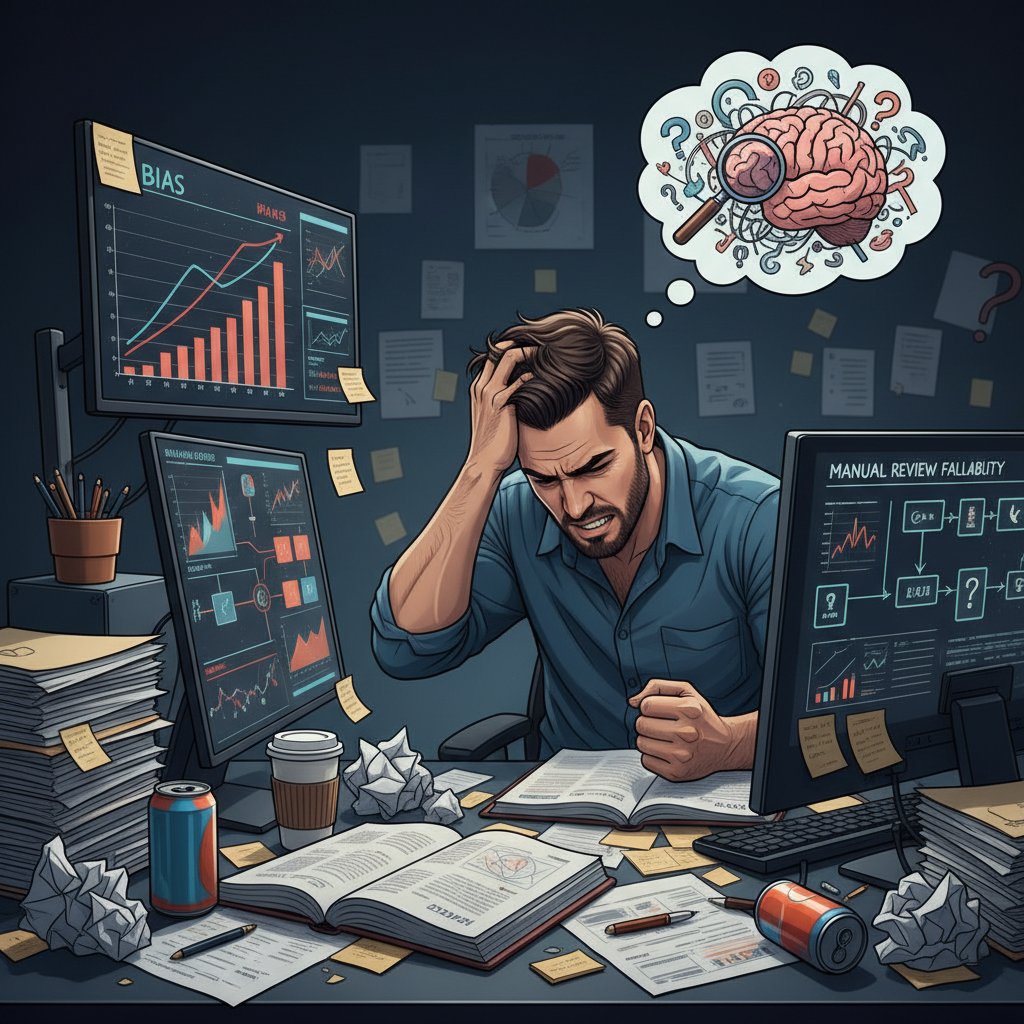
Unchecked, bias leads to disastrous calls—like greenlighting a contract because “it’s always worked before,” or dismissing red flags due to overconfidence in your review process.
The automation illusion: why AI isn’t a silver bullet
Relying blindly on automation is seductive—and reckless. Here’s what goes wrong when you let AI do all the thinking:
- False positives: Algorithms flag safe docs as risky, leading to wasted time and resources.
- Blind spots: Unusual or novel risks slip through undetected because they don’t fit the training data.
- Security gaps: Overreliance on cloud-based tools can backfire—2023 saw a 43% spike in cloud outages (FileCenter, 2025).
- Complacency: Teams disengage, assuming “the system will catch everything.”
The solution? Keep humans in the loop—always.
Real-world case files: when document analysis made—or broke—the outcome
Corporate meltdown: the billion-dollar oversight
In 2022, a global financial firm trusted AI-powered analysis for compliance review, skipping manual checks to “save time.” The bot missed a critical sanctions clause. The fallout? Over $1.2 billion in fines and a C-suite shakeup. No one saw it coming—except, perhaps, the analyst who raised a red flag that was ignored.

“We learned the hard way that trusting black-box algorithms without oversight can destroy a company overnight.”
— Senior compliance officer, post-event interview (ISACA, 2024)
Government decisions under the microscope
Document analysis isn’t just a corporate sport—governments live and die by the accuracy of their paperwork. Here’s how document-driven missteps have shaped public policy:
| Government Agency | Document Type | Decision Outcome | Ramifications |
|---|---|---|---|
| Health Ministry | Pandemic agreements | Overlooked supply clauses | Shortages, delays |
| Tax Office | Regulatory filings | Misinterpreted exemptions | Revenue loss |
| Defense Ministry | Procurement contracts | Missed compliance terms | Legal challenges |
Table 5: High-profile government document analysis failures. Source: Original analysis based on ISACA, 2024 and public audit reports.
The lesson? Public trust and billions in taxpayer dollars can hinge on a single page buried in a mountain of files.
Journalism’s last line of defense: document truth-seeking
Investigative journalism thrives on document analysis—think the Panama Papers or court leaks. When journalists unraveled the truth behind government cover-ups, it wasn’t magic: it was relentless, systematic document review powered by both technology and human grit.

Without this level of vigilance, many modern scandals would never see the light of day.
Lessons from the front lines: what survivors wish they knew
- Never skip the second pass: Always re-review, especially when stakes are high—first impressions miss what’s hidden in plain sight.
- Question every “standard” clause: The most dangerous risks are hiding in the routine, not the unusual.
- Mix teams, mix tools: Diversity in expertise and technology surfaces blind spots.
- Document your decisions: Audit trails protect you when the blame game starts.
- Don’t trust “set it and forget it” automation: Revisit your process regularly—complacency is fatal.
Every survivor of a document-driven disaster agrees: process discipline and healthy skepticism are non-negotiable.
Building your own document analysis decision-making system
Step-by-step: how to master document analysis in 2025
Transforming chaos into clarity isn’t luck—it’s a system. Here’s your no-nonsense guide:
- Define your goals: What, exactly, are you trying to find or decide?
- Gather and organize: Centralize all relevant documents; use smart platforms like textwall.ai/document-management.
- Set clear criteria: Before touching a file, establish what counts as a risk or opportunity.
- Automate the basics: Use AI to flag patterns, but don’t hand over the keys just yet.
- Manual review: Deep dive into flagged documents—context is king.
- Cross-check and validate: Never trust a single data point; triangulate with multiple sources.
- Summarize and report: Extract actionable insights, not just data dumps.
- Audit and improve: Document what worked (and what didn’t) after every review cycle.
This isn’t a one-and-done checklist—it’s a continuous refinement loop.
Red flags and self-audits: is your process broken?
- You spend more time searching for files than reading them.
- Critical decisions get delayed by “waiting for more data.”
- No one can explain why a document was approved—or by whom.
- Your AI output is never double-checked by a human.
- You’ve never updated your analysis criteria since launch.
If any of these sound familiar, your document analysis decision-making is on shaky ground.
Checklist: what the pros never skip
- Always establish clear decision criteria before review.
- Use AI for sorting, not final calls.
- Cross-validate critical findings with multiple sources or experts.
- Maintain detailed audit trails for all major decisions.
- Regularly retrain and test AI models for bias.
- Schedule recurring process audits—don’t wait for disaster.
Missing any of these? Fix it—now.
Integrating advanced tools (and when to say no)
Tech is only as smart as the process it supports. Integrate platforms like textwall.ai to automate the grunt work—summarizing, categorizing, and highlighting—but always stay ready to intervene when nuance or ethical judgment is needed.

Remember, the best tools don’t replace thinking—they amplify it.
The cost of complacency: hidden risks and how to fight back
Time sinks, blind spots, and false confidence
Complacency is the silent killer in document analysis decision-making. Here’s what it really costs:
| Complacency Risk | Real-World Consequence | Example Loss |
|---|---|---|
| Skipped reviews | Hidden liabilities | $100M+ fines |
| Outdated criteria | Missed emerging threats | Regulatory action |
| Infrequent audits | Process gaps exploited | Security breaches |
| Overreliance on AI | Systemic blind spots | Automated bad decisions |
| Poor documentation | Blame with no accountability | Lawsuits, firings |
Table 6: The hidden cost of complacency in document analysis decision-making. Source: Original analysis based on ISACA, 2024.
Don’t let inertia sink your ship.
Data privacy, security, and ethical dilemmas
- Data privacy: Failure to safeguard sensitive documents risks fines and reputational ruin.
- Security: Every new tool is a potential attack surface; vet vendors for real compliance.
- Ethical review: Just because AI can process everything doesn’t mean it should—some decisions require a human conscience.
- Transparency: Keep a clear trail—who, what, when, and why for every document decision.
Every document analysis system is only as strong as its weakest ethical link.
Mitigation strategies for the real world
- Implement layered reviews: Combine automated and manual checks by different teams.
- Regularly retrain AI tools: Use diverse, bias-aware datasets.
- Enforce access controls: Sensitive documents require strict permissions.
- Schedule recurring audits: Don’t wait for a crisis to test your process.
- Educate your teams: Awareness training beats ignorance every time.
- Maintain vendor accountability: Demand transparent reporting from all tech providers.
- Test disaster recovery: Simulate failures and refine your response.
Resilience isn’t built overnight—but every step above buys you insurance against disaster.
What’s next? The future of document analysis decision-making
AI on the edge: emerging tech and tomorrow’s risks
AI keeps getting smarter, but so do the threats. The next generation of tools can process unstructured data, video transcripts, and even voice memos—but every advance brings new vulnerabilities.

Staying ahead means balancing innovation with skepticism.
The human factor: why judgment still matters
“Data alone isn’t enough—real expertise comes from knowing when to trust your gut and when to challenge it.”
— Quoted in Sage Advice, 2024
It’s not just about reading documents—it’s about reading between the lines, understanding context, and anticipating fallout. That’s something no algorithm can do—at least, not yet.
How to stay ahead: continuous improvement and learning
- Audit often: The threats of yesterday aren’t the threats of today.
- Update checklists and criteria as standards evolve.
- Invest in training: Tech changes fast; keep your team even faster.
- Solicit feedback from front-line analysts.
- Review and revise processes after every incident—no exceptions.
Document analysis decision-making is a moving target—adapt or risk irrelevance.
Beyond the basics: advanced tactics, tools, and resources
Expert hacks for extracting deeper insights
- Use document clustering to group related files and surface hidden patterns.
- Leverage metadata analysis—often, what’s not in the text is more revealing than what is.
- Deploy anomaly detection algorithms on change logs and document histories.
- Apply visual heatmapping to contracts to spot areas consistently skipped during review.
- Integrate domain-specific ontologies for better context detection in legal, financial, or technical documents.
These are the tricks experts use to turn ordinary reviews into high-impact intelligence.
Benchmarking your process: where do you stand?
| Benchmark Metric | Industry Average | Your Process | Best Practice Target |
|---|---|---|---|
| Document retrieval time | 10 mins | ? | <2 mins |
| Compliance error rate | 5% | ? | <1% |
| AI-to-human flag ratio | 80:20 | ? | 50:50 |
| Review cycle time | 3 days | ? | 1 day |
| Audit frequency | Biannual | ? | Quarterly |
Table 7: Key benchmarks for evaluating document analysis decision-making. Source: Original analysis based on Adobe Acrobat survey, 2023 and ISACA, 2024.
How do you compare?
Leveraging platforms like textwall.ai for real advantage
Smart organizations don’t go it alone—they harness platforms like textwall.ai/advanced-document-analysis, which use state-of-the-art AI to instantly analyze, summarize, and extract actionable insights from even the most complex documents. The result? Faster decisions, sharper accuracy, and a real edge over the competition.

Supplementary deep dives: what everyone overlooks
Document analysis in crisis and disaster response
When disasters strike, document analysis decision-making isn’t academic—it’s life or death. Emergency response teams must extract critical information from incident reports, protocols, and legal documents in real time. One overlooked instruction can spell chaos on the ground.

This is where streamlined systems and clear criteria save lives, not just reputations.
The culture of documentation: global perspectives and taboos
- In some cultures, documentation is gospel—every decision must be paper-trailed.
- Elsewhere, verbal agreements reign, and over-documenting signals mistrust.
- Legal frameworks vary wildly—what’s binding in one country is unenforceable elsewhere.
- Taboos around documenting sensitive information can impede transparency or foster corruption.
- Cross-cultural teams must adapt their analysis styles to avoid costly misunderstandings.
Understanding the global terrain is as critical as mastering the technical tools.
Controversies and debates: who really owns the truth?
“In the end, documents don’t tell you the truth—they only tell you what someone wanted you to know. The real challenge is reading what’s between the lines.”
— Investigative journalist, as referenced in Scribd, 2023
Ownership of information, transparency, and the politics of documentation are battlegrounds in every high-stakes arena—from boardrooms to war zones.
Conclusion
Document analysis decision-making is a proving ground—where your ability to outthink chaos, sidestep bias, and harness the right mix of human and machine intelligence determines if you survive or stumble. Forget the myth that “more data” means better decisions; as research from ISACA, 2024 and Scribd, 2023 makes clear, clarity, criteria, and skepticism are your real weapons. Whether you’re a corporate analyst, a legal pro, or a journalist chasing truth, the survival kit is the same: blend AI speed with human expertise, question everything, and never let complacency creep in. Platforms like textwall.ai are rewriting the playbook—making it possible to tame the data deluge and make decisions that stand up to the toughest scrutiny. The next document you analyze could be the one that defines your legacy. Don’t just read—interrogate, cross-check, and always, always look twice.
Sources
References cited in this article
- ISACA: Avoiding Analysis Paralysis(isaca.org)
- Scribd: Emotional Bias in Decisions(scribd.com)
- TheCConnects: Steve Jobs Example(thecconnects.com)
- RIB Software: Data-Driven Decision-Making(rib-software.com)
- FileCenter: Document Management Stats(filecenter.com)
- Business.com: Document Management Risks(business.com)
- Alliance for Justice: Supreme Court Review(afj.org)
- Business Research Insights: Market Size(businessresearchinsights.com)
- ICDAR 2024: Latest Advances(medium.com)
- Insight7: Evolution Overview(insight7.io)
- DocumentLLM: AI Benefits(documentllm.com)
- HaystackID: Legal AI Use(haystackid.com)
- Filevine: AI in Law(filevine.com)
- Lumivero: Document Analysis Basics(lumivero.com)
- Netguru: AI Document Analysis(netguru.com)
- RMA India: QRA Case Study(rmaindia.org)
- RSS: Statistics Under Pressure(rss.org.uk)
- Medium: 2024 NLP Trends(medium.com)
- MDPI: NLP Challenges(mdpi.com)
- StartUs Insights: NLP Trends(startus-insights.com)
- Springer: Hybrid ML Approaches(link.springer.com)
- Scribd: Decision Traps(scribd.com)
- Insight7: AI Bias Reduction(insight7.io)
- ExpertInstitute: Forensic Bias(expertinstitute.com)
- Critical AI Report 2024(bloodinthemachine.com)
- The National: AI Solutionism(thenationalnews.com)
- Forbes: AI Not a Silver Bullet(forbes.com)
- Financial Times: Business of Law Case Studies(ft.com)
- Harvard Business Review: Case Studies(store.hbr.org)
- SBAN: Government Policy Case Studies(antidisplacement.org)
- GOV.UK: Best Practice Report 2023–24(gov.uk)
- NLC: Supreme Court Decisions(nlc.org)
- Fair Work Ombudsman: Litigation Outcomes(fairwork.gov.au)
Transform Complex Documents Into Clear Insights
TextWall.ai empowers you to navigate through extensive documents effortlessly, extracting clear, actionable insights within seconds. Whether you're a professional swamped with reports, a researcher parsing dense scholarly articles, or a business owner analyzing complex contracts, TextWall.ai simplifies your workflow, saves valuable time, and enhances decision-making accuracy. Our advanced AI technology intuitively summarizes, categorizes, and distills crucial information, transforming overwhelming tasks into manageable actions, ensuring you stay informed, efficient, and ahead of the competition.
Get startedReady to Master Your Documents?
Join professionals who've transformed document analysis with TextWall.ai
Frequently Asked Questions
What is document analysis decision-making?
Document analysis decision-making is the process of extracting truth from large volumes of reports, contracts, and emails to make critical business decisions. It involves carefully reading and identifying key information, hidden risks, and red flags in documents that can significantly impact companies, careers, and entire industries.
Why is document analysis so high-stakes?
Document analysis is high-stakes because a single misread clause or overlooked detail can trigger major consequences—from billion-dollar financial losses to regulatory disasters. The article illustrates this with an example of a corporation that overlooked an environmental liability clause during a merger, which later triggered significant regulatory and financial problems.
What is mentioned as a tool for improving document analysis?
The article mentions textwall.ai as a tool that is 'quietly rewriting survival strategies' in industries dealing with large amounts of information and document analysis.
What does the article say about common myths in document analysis?
The article explicitly rejects the simplistic advice to 'read more carefully' and promises to expose 'dangerous myths' and 'the seductive illusion of more data,' suggesting that conventional approaches to document analysis are insufficient and potentially misleading.
Keep Reading
Explore more from Advanced document analysis

Document Analysis for Improved Accuracy When 99% Isn’t Enough

Document Analysis Software: Myths, Risks and the Competitive Edge

Best Software for Document Analysis When Mistakes Are Not an Option

Why Document-Based Decisions Fail and How to Fix Them

Document Analysis for Corporate Analysts: Risks and Realities in 2025
